

Egypt is one of the most fertile areas of Africa, and one of the
countries around the Mediterranean Sea. Because it is so fertile, people
came to live in Egypt earlier than in most places, probably around
40,000 years ago. At first, there were not many people, but gradually
Egypt became more crowded, so there was more need for a unified
government. Around 3000 BC, Egypt was first unified under one ruler, who
was called the Pharaoh.
From that time until around 525 BC, when Egypt was conquered by the
Persians, Egypt's history is divided into six different time periods.
These are called the Old Kingdom, the First Intermediate Period, the
Middle Kingdom, the Second Intermediate Period, the New Kingdom and the
Third Intermediate Period.
Old Kingdom: 2686 – 2160 BC. First Intermediate Period: 2160 – 2040 BC.
Middle Kingdom: 2040 – 1633 BC. Second Intermediate Period: 1786 – 1558
BC. New Kingdom 1558 – 1085 BC. Third Intermediate Period: 1085 – 525
BC. Persian Rule: 525 BC – 332 BC.
Man's first gods were the forces of nature. Terrifying and
unpredictable, they were feared rather than revered by our ancestors.
Yet while much of the world was in darkness, worshiping cruel
incarnations of natural forces, a river valley in Africa held a people
who followed a different path. They worshipped gods that were beautiful
to behold, luminous beings that walked the earth, guiding the human race
to Paradise. They had human forms but were much more powerful, yet like
humans, they got angry, despaired, fought with one another, had
children and fell in love. They lived lives very much like the people
who worshipped them, the ancient Egyptians.
They were gods to be feared yes, as all gods are, but they were also
gods to be loved. What's more the Egyptians enjoyed talking about the
gods. Like the gods of the Greeks and the Romans, the Egyptian gods
seemed to be made for storytelling. There were tales to educate, tales
to entertain, tales with morals, and in those stories, the gods did not
seem so unreachable. It was comforting to hear that the gods also wept
for those they had lost, to hear about the gods laughing, to learn that
the gods faced many of the same problems that the people did, albeit on a
grander scale. In learning about the gods on such an intimate level,
the Egyptians could better relate to the universe around them.
The ancient Egyptian practiced a belief system that was part totemism,
part polytheism, and part ancestor worship. There were numerous gods,
but rather than living on an isolated mountain or in an unreachable
heaven, many of them lived invisibly in the mortal world, acting through
sacred sites, animals or even chosen people. Furthermore, the spirits
of the deceased, if remembered and honored, could aid and guide the
living from the Afterlife.

Article Source: http://www.approvedarticles.com

1. Know the basics
Ramadan is a lunar month dedicated to sawm, or fasting, one of the five pillars of Islam. From sun-up to sun-down, the faithful abstain from food, drink, tobacco and sex to concentrate on spiritual renewal. After sunset, there’s a euphoric iftar, or meal, to break the fast, followed by a late-night feast and sahur, a meal before the sun comes up and fasting begins again. Yet Ramadan isn’t all daytime discipline and nightly parties: it’s a time of generosity and zakat, or charity, another of the five pillars of Islam. Fasting isn’t easy, so everyone slows down during the day – but you’ll also notice people going out of their way to extend small kindnesses.
2. Plan ahead
Like any holiday, Ramadan affects business as usual. Many venues operate with limited hours and staff, so try to book accommodation, transport and tours via internet or phone before you arrive. Even if offices have posted hours, call ahead to ensure someone’s available to meet your needs. Most restaurants close by day, so pack lunches or reserve ahead at restaurants that open for lunch in tourist areas.
3. Shift your schedule
Nightly festivities trump early bedtimes during Ramadan. Sunset streets come alive with light displays, music and offers of sweets at every intersection. After an iftar of dates, soup or savoury snacks, people of all ages binge on sweets until the late-night feast – followed by more visits and sweets, until wired kids finally wear themselves out. There’s no rush to get up the next day, unless shopping is on the agenda. Stores often close in the afternoon, and bargaining is more pleasant before midday heat kicks in and lack of water is felt. As sundown approaches, the mood turns upbeat, with Ramadan finery on display and tantalising aromas filling the streets.
4. Get into the Ramadan spirit
Don’t worry: you won’t be expected to fast during Ramadan. According to tradition, even Muslim travellers are exempt from fasting – it’s hard to do at home under controlled conditions, let alone in unfamiliar places. To show your support, avoid eating or drinking on the street in front of people who are probably fasting, and grant people privacy at prayer times.
5. Accept hospitality
When a new friend offers you special Ramadan sweets or invites you to a family feast, polite refusal would be crushing. You’re not obliged to return the favour or eat the sweets: you honour givers just by accepting their generosity in the spirit of Ramadan. Kindness can be repaid by practising zakat, and giving to a local charity.

Sharm el-Sheikh (Arabic: شرم الشيخ, Sharm al-Shaykh, pronounced [ˈʃɑɾˤm eʃˈʃeːx]) is a city situated on the southern tip of the Sinai Peninsula, in South Sinai Governorate, Egypt, on the coastal strip along the Red Sea. Its population is approximately 35,000 (2008). Sharm el-Sheikh is the administrative hub of Egypt's South Sinai Governorate which includes the smaller coastal towns of Dahab and Nuweiba as well as the mountainous interior, Saint Catherine's Monastery and Mount Sinai.
Name:
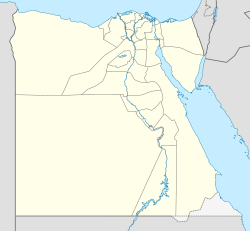
Sharm el-Sheikh is sometimes called the "City of Peace", referring to the large number of international peace conferences that have been held there. It was known as Şarm-üş Şeyh (Sharm ush-Sheikh, "bay of the Sheikh" in Arabic) during Ottoman rule and was known as Ofira during Israeli occupation between 1967 and 1982.[citation needed] Among Egyptians, the name of the city is commonly shortened to "Sharm" ([ʃɑɾˤm]).
Geography and history:
Sharm el-Sheikh is on a promontory overlooking the Straits of Tiran at the mouth of the Gulf of Aqaba. Its strategic importance led to its transformation from a fishing village into a major port and naval base for the Egyptian Navy. It was captured by Israel during the Suez Crisis of 1956 and restored to Egypt in 1957. A United Nations peacekeeping force was subsequently stationed there until the 1967 Six-Day War when it was recaptured by Israel. Sharm el-Sheikh remained under Israeli control until the Sinai peninsula was restored again to Egypt in 1982 after the Israel-Egypt Peace Treaty of 1979.
A hierarchical planning approach was adopted for the Gulf of Aqaba, whereby their components were evaluated and subdivided into zones, cities and centers. In accordance with this approach the Gulf of Aqaba zone was subdivided into four cities: Taba, Nuweiba, Dahab and Sharm El-Sheikh. Sharm el-Sheikh city has been subdivided into five homogeneous centers, namely Nabq, Ras Nusrani, Naama Bay, Umm Sid and Sharm El Maya.
A hierarchical planning approach was adopted for the Gulf of Aqaba, whereby their components were evaluated and subdivided into zones, cities and centers. In accordance with this approach the Gulf of Aqaba zone was subdivided into four cities: Taba, Nuweiba, Dahab and Sharm El-Sheikh. Sharm el-Sheikh city has been subdivided into five homogeneous centers, namely Nabq, Ras Nusrani, Naama Bay, Umm Sid and Sharm El Maya.
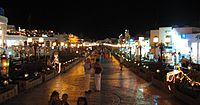
Sharm el-Sheikh city together with Naama Bay, Hay el Nour, Hadaba, Rowaysat, Montazah and Shark's Bay form a metropolitan area. Before 1967 Sharm el-Sheikh was little more than an occasional base of operations for local fishermen; the nearest permanent settlement was in Nabk, north of Ras el-Nasrani ("The Tiran Straits"). Commercial development of the area began during the Israeli presence in the area. The Israelis built the town of Ofira, overlooking Sharm el-Maya Bay and the Nesima area, and opened the first tourist-oriented establishments in the area 6 km north at Naama Bay. These included a marina hotel on the southern side of the bay, a nature field school on the northern side, diving clubs, a now well-known promenade, and the Naama Bay Hotel. After Sinai was restored to Egypt in 1982 the Egyptian government embarked on an initiative to encourage continued development of the city. Foreign investors – some of whom had discovered the potential of the locality during the Israeli occupation – contributed to a spate of building projects. Environmental zoning laws currently limit the height of buildings in Sharm el-Sheikh so as to avoid obscuring the natural beauty of the surroundings. In 2005, the resort was hit by the Sharm el-Sheikh terrorist attacks, which were perpetrated by an extremist Islamist organisation, and aimed at Egypt's tourist industry. Eighty-eight people were killed, the majority of them Egyptians, and over 200 were wounded by the attack, making it the deadliest terrorist action in the country's history (exceeding the Luxor massacre of 1997).[1] The city has played host to a number of important Middle Eastern peace conferences, including the 4 September 1999 agreement to restore Palestinian self-rule over the Gaza Strip. A second summit was held at Sharm on 17 October 2000 following the outbreak of the second Palestinian intifada, but it failed to end the violence. A summit was held in the city on 3 August 2005 on developments in the Arab world such as the situation in Iraq and the Arab-Israeli conflict. The World Economic Forum on the Middle East 2008 was also hosted by Sharm el-Sheikh. Amidst the 2011 Egyptian protests, President Hosni Mubarak reportedly went to Sharm el-Sheikh and resigned there on 11 February 2011.
Economy and tourism:


These natural resources, together with its proximity to European tourism markets, have stimulated the rapid growth of tourism that the region is currently experiencing. The total number of resorts increased from three in 1982 to ninety one in 2000. Guest nights also increased in that period of time from sixteen thousand to 5.1 million. Companies which have been attracted to invest in this city include Hyatt Regency, Accor, Marriott, Le Méridien, Four Seasons, Ritz-Carlton, with categories of three to five stars. In 2007 the area saw the opening of its first aqua park hotel resort. The four star Aqua Blu Sharm Resort was built on the Ras Om El Seid, with an area of 133,905 square metres (1,441,340 sq ft). Sharm is also the home of a congress center, located along peace road, where many international political and economic meetings have been held, including peace conferences, ministerial meetings, world bank meetings, Arab League.[citation needed] The Maritim Sharm el-Sheikh International Congress Centre can host events and congresses for up to 4,700 participants. The nightlife of Sharm El-Sheikh is modern and developed. In 2005, Little Buddha, a sushi bar, nightclub, and bar, took the title of having the longest continuous bar in the Middle East. Dance club franchise Pacha has one of its three African clubs in Sharm (the other two are in Morocco and Nigeria). These nightclubs and restaurants contribute greatly to the lifestyle led by Sharm el-Sheikh's visitors each year. The colorful handicraft stands of the local Bedouin culture are a popular attraction. Ras Mohammed, at the southern-most tip of the peninsula, has been designated a national park, serving to protect the area's wildlife as well as its natural landscape, shoreline and coral reef. A number of international hotels and noted restaurants are clustered around the centre of Sharm, known as Naama Bay, with golf courses and other leisure facilities further up the coast. The Nabq Managed Resource Protected Area is a 600 square kilometres (230 sq mi) area of mangroves, coral reefs, fertile dunes, birds and wildlife. Outings to places such as Cairo and the Great Pyramids require a crossing of a continental border (crossing from Asia to Africa) which requires a travel visa that must be acquired from Sharm el Sheik airport.
Sharm's marina has been redeveloped for private yachts and sailboats, with a passenger terminal for cruise ships and scheduled ferry service to Hurghada and Aqaba. Sharm el-Sheikh International Airport in addition to scheduled flights to Cairo, Hurghada, Luxor, Alexandria.Sharm has frequent coach services to Cairo leaving from the Delta Sharm bus station.

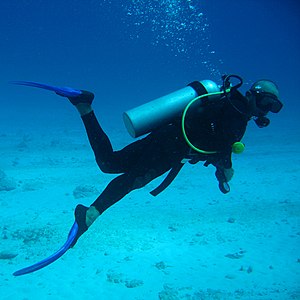
Sharm el-Sheikh has also become a favourite spot for scuba divers from around the world. Being situated near the Red Sea, it provides some of the most stunning underwater scenery and warm water making this an ideal place to dive. Visitors to Sharm el-Sheikh can experience a variety of water and activities. Beach seekers find many activities such as diving, snorkelling, windsurfing, kitesurfing, para-sailing, boating, and canoeing. Ras Mohammed is the national park of South Sinai, located on the tip of the Sinai Peninsula. Along with Nabq, it has famous dive sites in the Red Sea, with 800-metre (2,600 ft) deep reef walls, pounding current and coral gardens. The Sharm el-Sheikh Hyperbaric Medical Center was founded in 1993 with a grant from USAID by the Egyptian Ministry of Tourism, represented by Dr. Adel Taher to assist with diving related illnesses and complete the area's reputation as a full-service dive destination
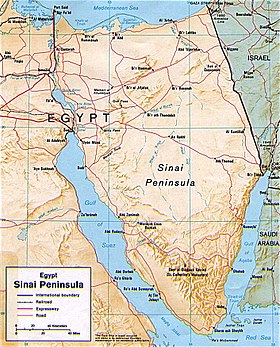
The Sinai Peninsula or Sinai (Arabic: سيناء sīnā' ; Hebrew סיני) is a triangular peninsula in Egypt about 60,000 km2 (23,000 sq mi) in area. It is situated between the Mediterranean Sea to the north, and the Red Sea to the south, and it is the part of Egyptian territory located in Asia as opposed to Africa. The bulk of the peninsula is divided into two governorates (with three more splitting the Suez Canal area), and has a population of approximately 500,000 people. The region has historically been the center of conflict between various political factions, based largely on its location. In addition to periods of direct rule by Egyptian governments (including the Ayyubids, the Mamluks, the Muhammad Ali Dynasty, and the modern Egyptian republic), it was like the rest of Egypt also occupied and controlled by the Ottoman Empire, and the United Kingdom which occupied Egypt from 1882 till 1956. Israel gained control of the Sinai in the Suez Crisis of 1956 and during the Six Day War of 1967. In the October War of 1973, it was the site of fierce fighting between Egyptian and Israeli forces. In 1982, after the Israel-Egypt Peace Treaty of 1979, Israel withdrew from the entirety of Sinai. Today, Sinai has become a tourist destination due to its natural setting, rich coral reefs, and biblical history. Mount Sinai is one of the most religiously significant places in Abrahamic faiths.
Sinai History

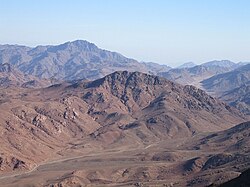
Sinai was inhabited by the Monitu and was called Mafkat or Country of Turquoise.[2] From the time of the First dynasty or before, the Egyptians mined turquoise in Sinai at two locations, now called by their Arabic names Wadi Maghareh and Serabit el-Khadim. The mines were worked intermittently and on a seasonal basis for thousands of years. Modern attempts to exploit the deposits have been unprofitable. These may be the first known mines. According to the Jewish tradition the peninsula was crossed by the Israelites during The Exodus from Egypt as detailed in the Hebrew Bible. This included numerous halts over a 40 year period of travel in AM 2448 (1313 BCE) in the Jewish tradition. The peninsula was governed as part of Egypt under the Mamluk Sultanate from 1260 until 1517, when the Ottoman Sultan, Selim the Grim, defeated the Mamluks at the Battles of Marj Dabiq and al-Raydaniyya, and incorporated Egypt into the Ottoman Empire. From then until 1906, Sinai was administered by the Ottoman provincial government of the Pashalik of Egypt, even following the establishment of the Muhammad Ali Dynasty's rule over the rest of Egypt in 1805. In 1906, the Ottoman Porte formally transferred administration of Sinai to the Egyptian Government, which essentially meant that it fell under the control of the United Kingdom, who had occupied and largely controlled Egypt since 1882. The border imposed by the British runs in an almost straight line from Rafah on the Mediterranean shore to Taba on the Gulf of Aqaba. This line has served as the eastern border of Egypt ever since.
At the beginning of the 1948 Arab-Israeli War, Egyptian forces invaded the former British Mandate of Palestine from Sinai as part of an attack by several Arab armies against the newly declared State of Israel. For a period during the war, Israeli forces entered the north-eastern corner of Sinai. With the exception of the Gaza Strip, which came under the administration of the All-Palestine Government (and was effectively put under Egyptian military administration), the western frontier of the former Mandate of Palestine became the Egyptian-Israeli frontier under the 1949 Armistice Agreement. In 1956, Egypt nationalized the Suez Canal on the western side of the Sinai Peninsula, and thereafter prohibited Israeli ships from using the Canal, in a violation of the armistice agreement signed in 1949. Egypt also prohibited ships traveling to and from Israel from using Egyptian territorial waters on the eastern side of the Peninsula, effectively imposing a blockade on the Israeli port of Eilat. Subsequently, Israeli forces, aided by Britain, and France (which sought to reverse the nationalization and regain control over the Suez Canal), invaded Sinai and occupied much of the Peninsula within a few days (see Suez Crisis). Several months later, following strong pressure from the United States and the Soviet Union, Britain, France and Israel withdrew their forces from Sinai. Thereafter, the United Nations Emergency Force (UNEF) was stationed in Sinai to prevent renewed conflict between the two states in Sinai.
Egypt-Israel border. Looking north from the Eilat Mountains
In 1967, Egypt reinforced its military presence in Sinai, renewed the blockade of Eilat, and on May 16 ordered the UNEF out of Sinai with immediate effect. Secretary-General U Thant eventually complied and ordered the withdrawal without Security Council authorization. After these Egyptian violations of the 1956 ceasefire agreements, in addition to Egyptian threats to attack and destroy the Jewish state, Israel invaded Sinai, commencing the Six-Day War. In this war, the Egyptian army was defeated, and Israel captured and occupied the entire peninsula. The Suez Canal, the east bank of which was now occupied by Israel, was closed. In the Yom Kippur War of 1973, Egyptian engineering forces built pontoon bridges to cross the Suez Canal, and stormed the supposedly impregnable Bar-Lev Line while many Israeli soldiers were observing a Jewish religious fast Yom Kippur. Though the Egyptians maintained control of most of the east bank of the Canal, in the later stages of the war, the Israeli military crossed the southern section of Canal, cutting off the Egyptian 3rd Army, and occupied a section of the west bank. After the war, as part of the subsequent Sinai Disengagement Agreements, Israel withdrew from the Canal, with Egypt's agreeing to permit passage of Israeli ships.
In 1979, Israel and Egypt signed a peace treaty in which Israel agreed to withdraw from the entirety of Sinai. Israel subsequently withdrew in several stages, ending in 1982. The Israeli pull-out involved dismantling almost all Israeli settlements, including the town of Yamit in north-eastern Sinai. The exception was Ofira, which had been developed into a resort town, which reverted to its Egyptian name of Sharm el-Sheikh. The treaty allowed monitoring of the Sinai by the Multinational Force and Observers, and limited the number of Egyptian military forces in the Peninsula. Over the years, Sinai was a site of several terrorist attacks targeting Westerners, Israelis and Egyptian tourists.
SINAI NOWDAYS
Over the past 30 years the Sinai has become a tourist destination due to its natural setting, rich coral reefs, and biblical history. The most popular tourist destination in Sinai are Mount Sinai ("Jabal Musa") and St. Catherine's Monastery, which is considered to be the oldest working Christian monastery in the world, and the beach resorts of Sharm el-Sheikh, Dahab, Nuweiba and Taba. Most tourists arrive through Eilat, Israel and the Taba Border Crossing, by train or bus from Cairo or by Ferry from Aqaba in Jordan.
Most of the Sinai Peninsula is divided among two Egyptian governorates, or provinces, named Ganub Sina ("South Sinai") and Shamal Sina ("North Sinai"). Three more governates span the Suez Canal, crossing into African Egypt. el-Sewais ("the Suez") is on the southern end of the Suez Canal, el-Isma'ileyyah in the center, and Port Said in the north. Approximately 66,500 people live in Ganub Sina and 314,000 live in Shamal Sina. Port Said itself has a population of roughly 500,000 people. Portions of the populations of el-Isma'ileyyah and el-Suweis live in Sinai, while the rest live on the western side of the Suez Canal. The combined population of these two governorates is roughly 1.3 million (only a part of that population live in the Sinai, while the rest live on the western side of the Suez Canal). Sinai is one of the coldest provinces in Egypt because of its high altitudes and mountainous topographies. Winter temperatures in some of Sinai's cities and towns reach −16 °C (3 °F). Large numbers of Egyptians from the Nile Valley and Delta have moved to the area to work in tourism, while at the same time development has negatively affected the native Sinai Bedouin population. In order to help alleviate these problems, various NGOs have begun to operate in the region including the Makhad Trust, a UK charity which assists the Bedouin in developing a sustainable income while protecting Sinai's natural environment, heritage and culture.

Despite Egypt's ancient allure, today the country probably attracts more beach vacationers than any other type of tourists. This is because, for many Europeans, the warm Egyptian beaches are both inexpensive and well appointed. Many European countries specifically lack warm beaches and the alternatives to Egypt are somewhat expensive. Therefore, not only do people come to Egypt's beaches independently, but many arrive by way of chartered airlines that specialize in such vacations from Europe. Depending on how one looks at it, Egypt can be said to have as many as seven beach zones. These consist of the Mediterranean beaches along the mainline coast from the Suez Canal over to Libya, the Mediterranean beaches along the northern Sinai, the Sinai coast along the gulf of Aqaba, the Sinai coast along the Gulf of Suez, the southern Sinai region which opens onto the Red Sea, the Mainland coast along the Gulf of Suez and the Mainland coast south of that along the Red Sea. Each of these areas vary either somewhat, or extensively from the others. Obviously the biggest differences are between the Mediterranean coast and all of the other regions that connect with the Red Sea. Some of these regions attract extensive tourism, while others are almost void of tourists. Some attract very specific tourists, while others are more generalized.

The North Coast from Libya East though the Sinai
In reality, the various regions are looked upon somewhat differently. For example, on the Egyptian mainland coast along the Mediterranean, there is a vast difference between the area from Alexandria over to Port Said from the region west of Alexandria. East of Alexandria is very populous along much of the Delta and not suitable for beaches until one reaches the northern Sinai. The beaches at Alexandria cater almost exclusively to Egyptians, with the exception of some specific resorts, who either have their own villas or apartments, or who stay in hotel facilities. In fact, probably most Egyptians come to Alexandria not for a beach vacation as such, but to escape the heat of Cairo.

In reality, the various regions are looked upon somewhat differently. For example, on the Egyptian mainland coast along the Mediterranean, there is a vast difference between the area from Alexandria over to Port Said from the region west of Alexandria. East of Alexandria is very populous along much of the Delta and not suitable for beaches until one reaches the northern Sinai. The beaches at Alexandria cater almost exclusively to Egyptians, with the exception of some specific resorts, who either have their own villas or apartments, or who stay in hotel facilities. In fact, probably most Egyptians come to Alexandria not for a beach vacation as such, but to escape the heat of Cairo.
West of Alexandria along the coast, thinning out as one proceeds further west, but extending almost to the Libyan border, are resorts that differ from the beach hotels and facilities to the east. These are frequently compounds, as opposed to real villages, some of which are very exclusive and have only recently been built. The main point is that, while indeed some foreign tourists can be found in this region, they are very few in number, other than tourists visiting Alexandria for more classical reasons. This, of course, may change over time.
The regions west of Alexandria has been called "underdeveloped". That too is rapidly changing, as new resorts are popping up all along the shoreline, particularly just west of Alexandria. One of the intriguing aspects of the Mediterranean coast beach resorts is that there is a certain amount of experimentation with various types of Beaches. For example, around Marina, one of Egypt's most exclusive northern beach resort areas, specific beaches have been set aside for women, who wish to enjoy the beach without interference from male eyes, and youth, where the atmosphere is a little more lively and geared to their pleasures.

Along the north Sinai coast there is today actually very little tourism. In fact, about the only well known tourist location is Al-Arish, which has tried to make a go of tourism but has not been too successful, even though there are some fairly nice hotels in the village.
The Gulf of Suez

What is not surprising is that the mainland beach along the Gulf of Suez is ever more popular among Egyptians, and may very well become more important to foreign tourists as well. Though perhaps not quite as warm as beaches further south, resort complexes such as Stella Di Mari, which already receives a large number of Italian tourists in particular, are very nice, relatively inexpensive, and an easy visit from Cairo. We have often praised this location, along an area known as Ain Sukhna, for its convenience to Cairo as a quick Red Sea jaunt (though it is actually on the Gulf of Suez), which also allows tourists close access to visit the Suez Canal, and fairly close access to the famous Eastern Desert Monasteries of St. Anthony and St. Paul. Though this area remains mostly a destination for Egyptians, we expect to see more and more foreign tourists in the future, for which it is well suited.

The Beach at Stella Di Mari
It is rather interesting that, along with the northern Mediterranean Sinai coast, the Sinai coast along the Gulf of Suez has not much been developed as a tourist destination, either for Egyptians or foreigners. This is not to say that no facilities exist, but they are very sparse.
The Mainland Coast Along the Red Sea

Where we begin to see the most foreign beach goers is as Egypt's mainland coast opens onto the Red Sea. Specifically, the and Hurghada region is one of the most popular beach areas in Egypt among foreign tourists. Hurghada has traditionally been known as one of the most affordable beach resort communities, though there are certainly more luxurious facilities available in the city proper, while El Gouna, just to the north, has strictly an upper class reputation. Just to the south of Hurghada is also the exclusive compound of Soma Bay, with several hotels and a fine golf course. As one travels further south along the mainland Egyptian coast, resorts areas become less dense, and many of the more southern tourist destinations are more scuba diving camps than resorts though, for example Marsa Alam is gaining in importance as a general tourist destination.

The eastern shore of the Sinai along the Gulf of Aqaba has a number of beach vacation resorts and towns, from the very northern tip of the Gulf all the way down to the southern end of the the Sinai. These areas really are frequented almost entirely by foreign tourists. However, they vary considerably, from Taba, which probably receives most of its tourism from Israel, down to Sharm el-Sheikh, which like Hurghada, is one of the main tourist destinations for beach goers to Egypt. In between Taba and Sharm el-Sheikh are Nuweiba and Dahab, which seem to cater to a mix of foreign tourists looking for perhaps a little less formal resorts and for that matter, less crowded resorts.

Types of Facilities
In Egypt, one of the nice things about its beach resorts is that just about every area seems to be interestingly different, and there are a wide range from the standpoint of expense. Facilities range from very rudimentary beach camps to the finest imaginable five star hotels, and include the possibility of villa rentals. In general, in the region south of Hurghada, not including Marsa Alam, beach camps and more rudimentary accommodations seem to be more dominant, but then so too are open beaches with little in the way of crowds. On the east, Aqaba side of the Sinai, while Taba and especially Sharm el-Sheikh are built up areas with fine facilities to choose from, the area in between these two destinations tend to be more camp-like, though there are certainly a few fine hotels here and there. These areas, south of Hurghada (and south of Soma Bay, and not including Marsa Alam), tend to be very laid back areas of beach with less formal entertainment facilities than the main tourist areas of El Gouna, Hurghada, Sharm el-Sheikh, Taba and more and more, Marsa Alam. However, even the grand tourist destinations can be very different.
For example, Hurghada is almost two cities in one. There is the downtown area with its less expensive hotels, some with beach front property, and then there are the individual resorts that are really somewhat segregated from the downtown area.
The more segregated beach resorts at Hurghada are not all that different from those further north in the area of Ain Sukhna and along the Northern mainland coast west of Alexandria. They are essentially self contained complexes that offer little availability to the main city of Hurghada. Tourists tend to not stray far from the compound where they are staying. On the other hand, El Gouna, just to the north of Hurghada is set up more to allow tourists in the various resorts to roam around in the small village. Sharm el-Sheikh is probably the most open resort area, with a boardwalk that connects most of the beach front resorts and the town center, though there are a few more isolated resorts.

What this means for the most part is that the entertainment possibilities in Sharm are much more varied. It should be noted that in many more isolated compounds, such as Stella Di Mari in the north, there may be more than enough activities and entertainment for most people. Many of the individual compounds such as this have more than one hotel, and work hard to include various forms of entertainment and activities for the whole family.
Scuba Diving and other Water Activities
One of the main differences between the the coastal regions that border the Red Sea and those in the Gulfs and Mediterranean Zones is the availability of Scuba Diving. There is some sparse scuba diving facilities in just about every zone, but by far, most Scuba Diving facilities are located from El-Gouna south along the Red Sea, and around Sharm el-Sheikh on the Sinai. In fact, perhaps as much as 80% of all Scuba Diving activities originate from the immediate region of Hurghada and Sharm el-Sheikh. This is not to say that activities such as snorkeling cannot be found at almost all beach areas. Furthermore, other activities such as windsurfing and skiing, while available in many different locations, seems to be very popular along the mainland Gulf of Suez Zone. At various locations on just about all of the beaches there are other water sports available, such as sail boat rentals and parasailing.
|
| Sinai |
The Sinai Peninsula or Sinai (Arabic: سيناء sīnā' ; Hebrew סיני) is a triangular peninsula in Egypt Africa [citation needed]. The bulk of the peninsula is divided into two governorates (with three more splitting the Suez Canal area), and has a population of approximately 500,000 people.
The region has historically been the center of conflict between various political factions, based largely on its location. In addition to periods of direct rule by Egyptian governments (including the Ayyubids, the Mamluks, the Muhammad Ali Dynasty, and the modern Egyptian republic), it was like the rest of Egypt also occupied and controlled by the Ottoman Empire, and the United Kingdom which occupied Egypt from 1882 onwards. Israel gained control of the Sinai in the Suez Crisis of 1956 and during the Six Day War of 1967. In the October War of 1973, it was the site of fierce fighting between Egyptian and Israeli forces. In 1982, after the Israel-Egypt Peace Treaty of 1979, Israel withdrew from the entirety of Sinai. Today, Sinai has become a tourist destination due to its natural setting, rich coral reefs, and biblical history. Mount Sinai is one of the most religiously significant places in Abrahamic faiths.
 |
| Upper Egypt |
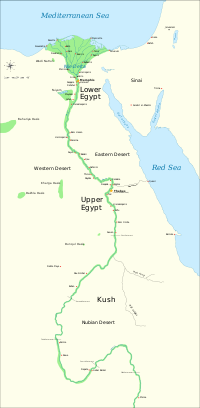
Upper Egypt (Arabic: صعيد مصر Sa'id Misr) is the strip of land,on both sides of the Nile valley, that extends from the cataract boundaries of modern-day Aswan north to the area between El-Ayait and Zawyet Dahshur (which is south of modern-day Cairo). The northern section of Upper Egypt, between El-Ayait and Sohag is sometimes known as Middle Egypt. The designation Upper Egypt is most frequently used as adivision for Ancient Egypt. Modern inhabitants of Upper Egypt are known as Sa'idis; they generally speak Sa'idi Arabic. Upper Egypt was known as Ta Shemau . which means "the land of reeds. It was divided into twenty-two districts called nomes. The first nome was roughly where modern Aswan is and the twenty-second was at modern Atfih (Aphroditopolis), just to the south of Cairo.
 |
| Cairo |
Cairo is as one of the most densely populated cities in the world. Nicknamed "The City of a Thousand Minarets" for its preponderance of Islamic architecture, Cairo has long been a centre of the region's political and cultural life. Cairo was founded by the Fatimid dynasty in the 10th Century, but the land composing the present-day city was the site of national capitals whose remnants remain visible in parts of Old Cairo. Cairo is also associated with Ancient Egypt due to its proximity to the ancient cities of Memphis, Giza and Fustat which are nearby to the Great Sphinx and the pyramids of Giza.
The English and French names for the city ("Cairo", and "Le Caire" respectively) are corruptions of its Arabic name "al-Qahira". Egyptians today often informally refer to Cairo as Maṣr (Arabic: مصر), the vernacular Egyptian pronunciation of Misr, the name for Egypt itself, emphasizing the city's continued central importance in the country. Cairo has the oldest and largest film and music industries in the Arab World, as well as the world's second-oldest institution of higher learning, al-Azhar University. Many international media, businesses, and organizations have regional headquarters in the city, and the Arab League has had its headquarters in Cairo for most of its existence.
With a population of (7,758,581) spread over 453 square kilometres (175 sq mi), Cairo is by far the largest city in Egypt. With an additional ten million inhabitants just outside the city, Cairo resides at the centre of the largest metropolitan area in Africa and the eleventh-largest urban area in the world.[7] Cairo, like many other mega-cities, suffers from high levels of pollution and traffic, but its metro – currently one of only two on the African continent – also ranks among the 15 busiest in the world,[8] with over 700 million passenger rides annually. The economy of Cairo was ranked first in the Middle East,[9] and 43rd globally by Foreign Policy's 2010 Global Cities Index.
Sharm el-Sheikh is the biggest town in the province of South Sinai also it is the international tourist center,where as it is famous for the sport of diving. South of it, there are the natural Ras Mohamed .. The total area of Sharm el-Sheikh is about 424 kg m 2. Sharm el-Sheikh is rhe most famous tourist city in the Sinai, and the tourist activity had developed significantly in the last twenty years, The importance of the Sharm el-Sheikh is in its location at the head of the Red Sea, it is then divided into the Gulfs of Suez and Aqaba, which led to an environment more unique is the key element in the tourist attractions. So there are the most important natural reserves in the Ras Mohammed and Nabq. At the front of Sharm el-Sheikh there are islands of Tiran and Sanafir at the entrance to the Gulf of Aqaba .. One of the main areas and Ras Nasrani Ras Umm Sid to the Ras Mohammed .
a strong infrastructure of facilities and services are available in Sharm el-Sheikh and increasing of the number of inhabitants in large, reaching more than ten thousand people are estimated to be about 132 thousand people in 2017 with the increasing tourism activities in particular .


